CAC News
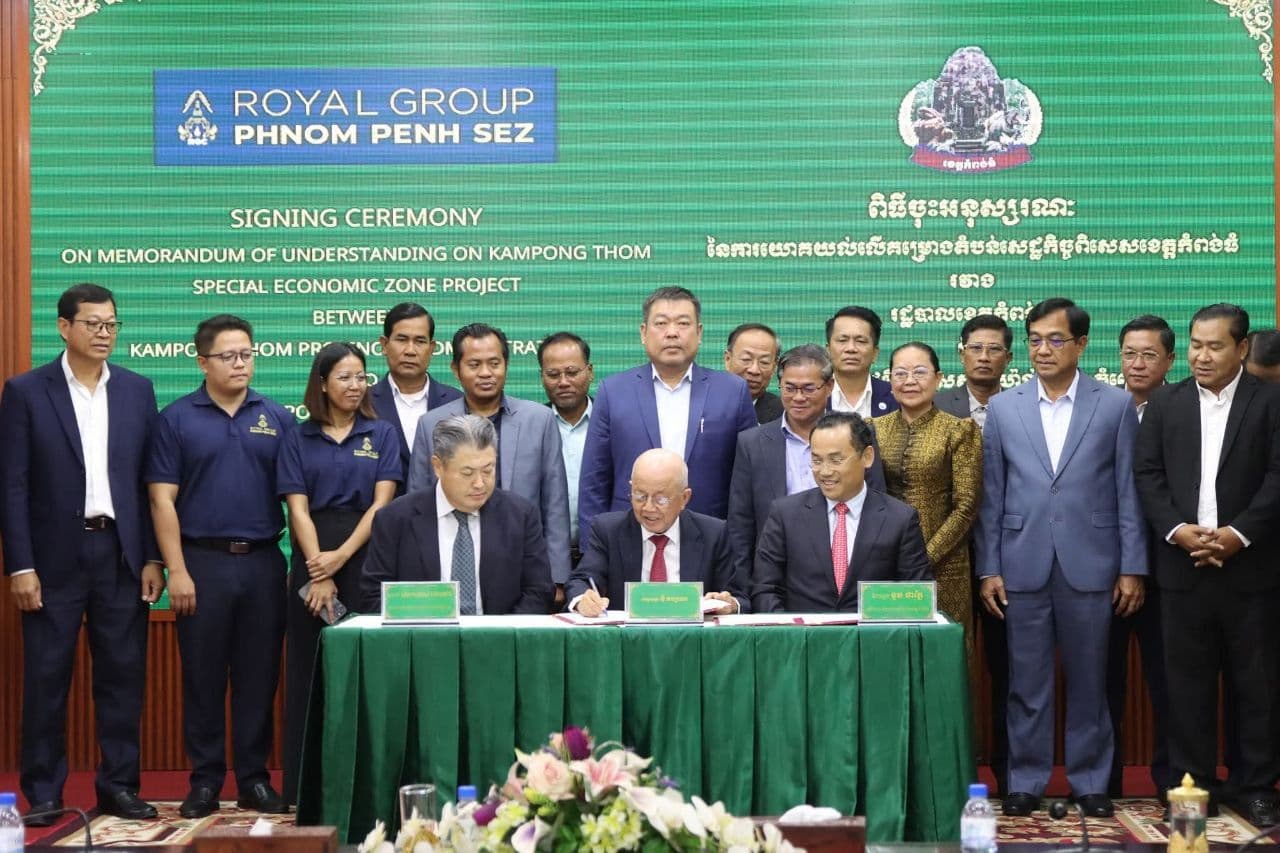
Kampong Thom, January 7, 2026 — The Kampong Thom Provincial Administration and Royal Group Phnom Penh SEZ Plc. on Tuesday signed a Memorandum of Understanding (MOU) to conduct a feasibility study on the establishment of the Kampong Thom Agri-Industrial Park, a project aimed at boosting local agro-processing capacity and value addition.
The proposed Agri-Industrial Park will focus on the processing of a wide range of agricultural products, excluding cashew nuts. The initiative is designed as a companion project to a major Cashew Nut Processing Industrial Park (CIP), with both developments being initiated, promoted, and strongly supported by Samdech Moha Borvor Thipadei Hun Manet, Prime Minister of the Kingdom of Cambodia.
Speaking at the signing ceremony held at the Kampong Thom Provincial Hall, H.E. Nuon Pharat, Governor of Kampong Thom Province, said that under the Prime Minister’s long-term vision and dynamic leadership, the provincial administration has been working continuously to strengthen the local economy and improve the livelihoods of citizens.
“The development of agro-industrial infrastructure is a key driver for sustainable economic growth in Kampong Thom,” the governor noted, adding that the feasibility study will help determine the most effective and viable approach for the project’s implementation.
Mr. Uon Silot, President of the Cashew Nut Association of Cambodia (CAC), welcomed the initiative and highlighted Kampong Thom’s strong agricultural potential, particularly in cashew nuts, rubber, rice, and cassava. He said the province produces an average of 220,000 tons of cashew nuts annually, representing about 25 percent of Cambodia’s total output.
Kampong Thom was previously selected by the government as the site for a 400-hectare Cashew Industrial Park, which is expected to provide significant incentives to investors, including benefits related to customs procedures, taxation, water and electricity costs, and logistics. These incentives are intended to enhance the competitiveness of Cambodia’s cashew sector in international markets.
Mr. Silot Uon added that if the CIP is established as planned, Cambodia’s cashew industry would see substantial growth in line with the National Policy on Cashew Nuts. However, he noted that while awaiting the creation of the CIP, efforts to attract investors through Qualified Investment Project (QIP) status in the cashew sector have stalled for nearly two years.
As a result of the delay, several cashew processing factories have been encouraged to shift their investments to northeastern provinces such as Kratie, Stung Treng, Ratanakiri, and Mondulkiri, which currently offer incentives comparable to those proposed for the Kampong Thom CIP.
According to unofficial figures from the Cashew Nut Association of Cambodia, in 2025 cashew production reached approximately 1,020,757 tons, with around 1,000,757 tons of raw cashew nuts exported to international markets. These exports generated an estimated $1.5 billion in revenue, marking a 27 percent increase compared to the previous year. The total cashew cultivation area nationwide is estimated at 700,000 hectares.
Officials and industry representatives expressed optimism that the feasibility study for the Kampong Thom Agri-Industrial Park, alongside progress on the Cashew Industrial Park, will help unlock the province’s agricultural potential and strengthen Cambodia’s agro-industrial value chain.