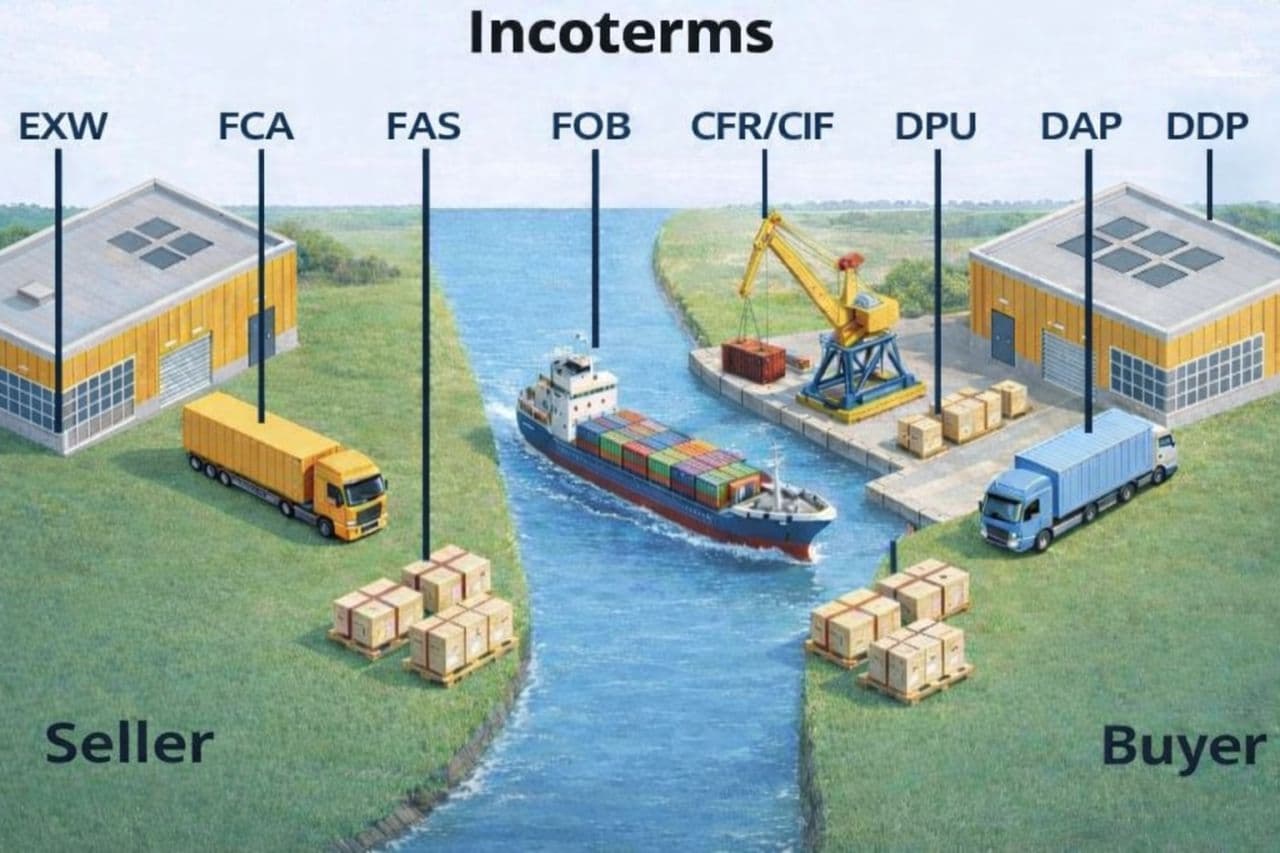
The terms are arranged from minimum seller responsibility (EXW) on the left to maximum seller responsibility (DDP) on the right.
1. EXW – Ex Works
Seller's responsibility: Minimum
- Seller makes goods available at their factory or warehouse.
- Buyer arranges loading, transport, export clearance, shipping, import clearance, and delivery.
- Risk transfers when goods are made available to the buyer.
Example: A Cambodian cashew processor sells kernels EXW Phnom Penh. The foreign buyer handles everything from pickup onward.
2. FCA – Free Carrier
- Seller delivers goods to a carrier nominated by the buyer.
- Seller handles export customs clearance.
- Risk transfers once goods are handed to the carrier.
Common for: Container shipments and multimodal transport.
3. FAS – Free Alongside Ship
Sea freight only
- Seller delivers goods alongside the vessel at the port.
- Buyer pays loading, ocean freight, insurance, and import costs.
- Risk transfers when goods are placed alongside the ship.
Common for: Bulk commodities such as grain, minerals, or raw cashew nuts.
4. FOB – Free On Board
Sea freight only
- Seller delivers and loads goods onto the vessel.
- Buyer pays ocean freight and insurance.
- Risk transfers once goods are on board the ship.
Very common in agricultural exports.
Example: Cambodian RCN exported FOB Sihanoukville Port.
5. CFR – Cost and Freight
Sea freight only
- Seller pays freight to the destination port.
- Buyer bears risk once goods are loaded onto the vessel.
- Insurance is not included.
Key point: Seller pays shipping costs, but the buyer assumes the risk during transit.
6. CIF – Cost, Insurance and Freight
Sea freight only
- Seller pays:
- Ocean freight
- Marine insurance
- Export costs
- Buyer assumes risk after goods are loaded onto the vessel.
Common for international commodity trading.
Example: Cashew kernels sold CIF Shanghai.
7. DPU – Delivered at Place Unloaded
- Seller bears all costs and risks to the destination.
- Seller is responsible for unloading.
- Buyer handles import clearance and duties.
Unique feature: Seller pays for unloading.
8. DAP – Delivered at Place
- Seller delivers goods to an agreed destination.
- Goods remain on the truck or transport vehicle.
- Buyer handles unloading, import duties, and taxes.
Common for: Cross-border land transport.
9. DDP – Delivered Duty Paid
Seller's responsibility: Maximum
- Seller pays:
- Transport
- Insurance
- Export clearance
- Import clearance
- Duties and taxes
- Buyer receives the goods.
Most convenient for buyers, but highest risk and cost for sellers.
Quick Comparison
| Term | Export Clearance | Freight | Insurance | Import Duties | Main Risk Transfer |
|---|---|---|---|---|---|
| EXW | Buyer | Buyer | Buyer | Buyer | Seller's premises |
| FCA | Seller | Buyer | Buyer | Buyer | Carrier |
| FAS | Seller | Buyer | Buyer | Buyer | Alongside ship |
| FOB | Seller | Buyer | Buyer | Buyer | On board a vessel |
| CFR | Seller | Seller | Buyer | Buyer | On board vessel |
| CIF | Seller | Seller | Seller | Buyer | On board vessel |
| DPU | Seller | Seller | Seller | Buyer | After unloading |
| DAP | Seller | Seller | Seller | Buyer | At destination |
| DDP | Seller | Seller | Seller | Seller | At destination |
Which Incoterms are most common in the cashew trade?
For Cambodia's cashew industry, the most frequently used terms are:
- FOB – Raw cashew nuts (RCN) exported to Vietnam, India, and China.
- CIF – Cashew kernels sold to overseas buyers who want freight and insurance included.
- FCA – Containerized shipments from processing factories.
- DDP – Small-volume sales to retailers or distributors where the seller handles the entire logistics chain.
For large-volume raw cashew nut exports from Cambodia to Vietnam, FOB remains the most commonly negotiated Incoterm because it clearly separates the seller's and buyer's responsibilities at the port of shipment.