CAC News
PHNOM PENH, June 2026 — Global cashew trade data is highlighting a significant imbalance in the industry's value chain, with major producing nations exporting vast quantities of raw cashew nuts while a handful of processing hubs capture most of the industry's export earnings.
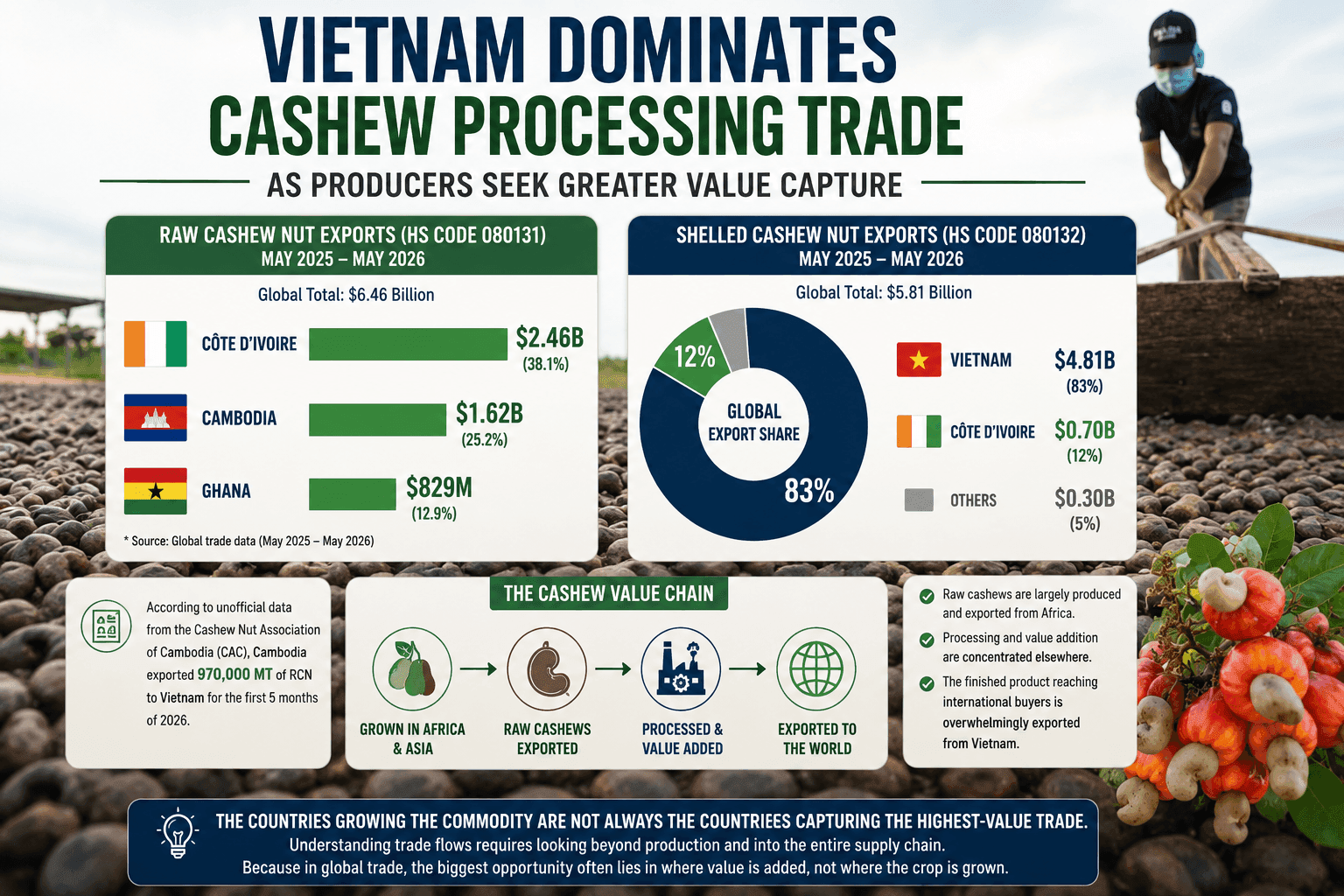
According to trade data covering the period from May 2025 to May 2026, Côte d'Ivoire remained the world's largest exporter of raw cashew nuts, accounting for exports valued at approximately $2.46 billion, or 38.1% of global trade. Cambodia ranked second with $1.62 billion in exports, representing 25.2% of the market, followed by Ghana with $829 million, or 12.9%.
The figures confirm the dominant role of African producers and Cambodia in supplying raw cashew nuts to international markets. However, a different picture emerges when examining exports of shelled cashew nuts, the processed and export-ready product that commands significantly higher value.
Vietnam overwhelmingly dominates this segment of the market. During the same period, the country exported $4.81 billion worth of shelled cashew nuts, accounting for nearly 83% of global exports. Côte d'Ivoire, the second-largest exporter of processed cashews, held only about 12% of the market.
The contrast underscores a key trend in the global cashew industry: while raw cashew production is concentrated in Africa and parts of Asia, processing and value addition are heavily concentrated in Vietnam.
Industry observers note that the distribution of value across the supply chain has major implications for producer countries. Nations that primarily export raw cashew nuts often capture only a fraction of the final product's value, while countries with large-scale processing industries benefit from higher margins, job creation, and stronger export revenues.
Cambodia's trade relationship with Vietnam illustrates this dynamic. According to unofficial data from the Cashew Nut Association of Cambodia (CAC), Cambodia exported approximately 970,000 metric tons of raw cashew nuts (RCN) to Vietnam during the first five months of 2026. Much of this volume is subsequently processed and re-exported by Vietnamese companies to global markets.
The findings highlight the growing importance of developing domestic processing capacity in producing countries. As governments seek to increase export earnings and strengthen agricultural value chains, investment in processing infrastructure is increasingly viewed as a strategic priority.
Experts say the lesson from the cashew industry is clear: in global trade, the greatest opportunities often lie not in growing the crop, but in adding value before it reaches international buyers.
As demand for processed food products continues to grow worldwide, the ability to move beyond raw commodity exports may determine which countries capture the largest share of future profits in the global cashew market.
Reference: Export Genius