Mid-April 2026—CAC News
The global cashew market appears stable on the surface but is facing growing structural and geopolitical complexities, according to the latest Global Markets report released by the African Cashew Alliance (ACA).
Industry analysts note that while price movements remain relatively contained, deeper imbalances in supply, demand, and trade flows are shaping a more uncertain outlook for the months ahead.
Supply Outlook Mixed Across Regions
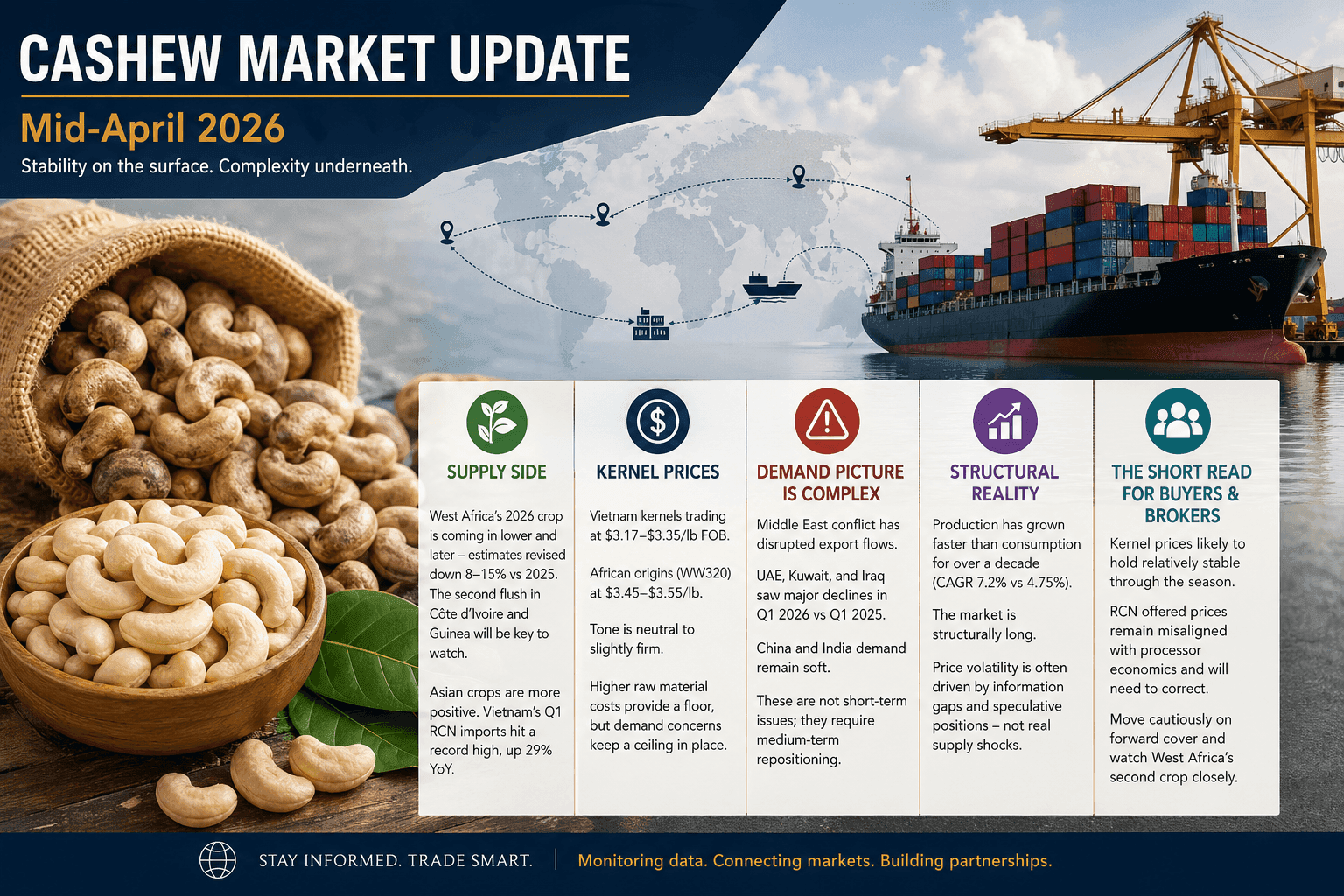
On the supply side, West Africa—the world’s leading cashew-producing region—is experiencing a weaker and delayed 2026 harvest. Current estimates suggest output could fall between 8% and 15% compared to 2025 levels, depending on final crop performance. Market observers are closely monitoring the second harvest cycle in Côte d’Ivoire and Guinea, which is expected to play a decisive role in determining overall supply.
In contrast, Asian producers are showing stronger performance. Vietnam and India have reported relatively positive crop conditions, with Vietnam recording a 29% year-on-year increase in raw cashew nut (RCN) imports during the first quarter of 2026—marking a record high.
Kernel Prices Remain Range-Bound
Cashew kernel prices are currently trading within a narrow range, reflecting a balance between supply pressures and subdued demand. Vietnamese kernels are quoted at $3.17 to $3.35 per pound (FOB), while African-origin WW320 grades are slightly higher at $3.45 to $3.55 per pound.
Market sentiment remains neutral to slightly firm. Rising raw material costs are providing a price floor, but weak demand in key markets continues to cap upward momentum.
Demand Disruptions Weigh on Market
Demand conditions, however, are proving more complex. Ongoing conflict in the Middle East has significantly disrupted export flows, leading to sharp declines in shipments to key markets such as the United Arab Emirates, Kuwait, and Iraq during the first quarter of 2026.
Meanwhile, demand from major consuming countries, including China and India, remains subdued. Analysts warn that these challenges are unlikely to be short-lived and may require traders and exporters to adjust strategies over the medium term.
Structural Imbalance Persists
Beyond short-term fluctuations, the cashew market continues to face a long-standing structural imbalance. Over the past decade, global production has grown at an average annual rate of 7.2%, outpacing consumption growth of 4.75%. This has resulted in a market that is structurally oversupplied.
As a result, price volatility is often driven less by actual supply shocks and more by information asymmetry and speculative trading behavior, according to the report.
Cautious Outlook for Buyers and Traders
For buyers and brokers, the near-term outlook suggests continued price stability throughout the current season. However, analysts highlight a misalignment between raw cashew nut prices and processor margins, indicating that adjustments may be necessary.
Market participants are advised to exercise caution when entering forward contracts and to closely monitor developments in West Africa’s second crop cycle, which could significantly influence supply dynamics in the coming months.
Reference Prosi Group