Global Desk — Agricultural trade is undergoing a profound transformation, shifting from a straightforward exchange of goods into a complex, highly structured global system shaped by logistics networks, financial integration, and geopolitical dynamics.
Industry experts say the sector is no longer defined solely by production volumes, but increasingly by who controls supply chains, trade routes, and market access.
Global Leaders Dominate Structured Trade System
United States | ██████████████████████████████████████████████████ 171
Netherlands | ██████████████████████████████████████████ 137
Brazil | █████████████████████████████████████████ 130
China | ████████████████████████████████ 99
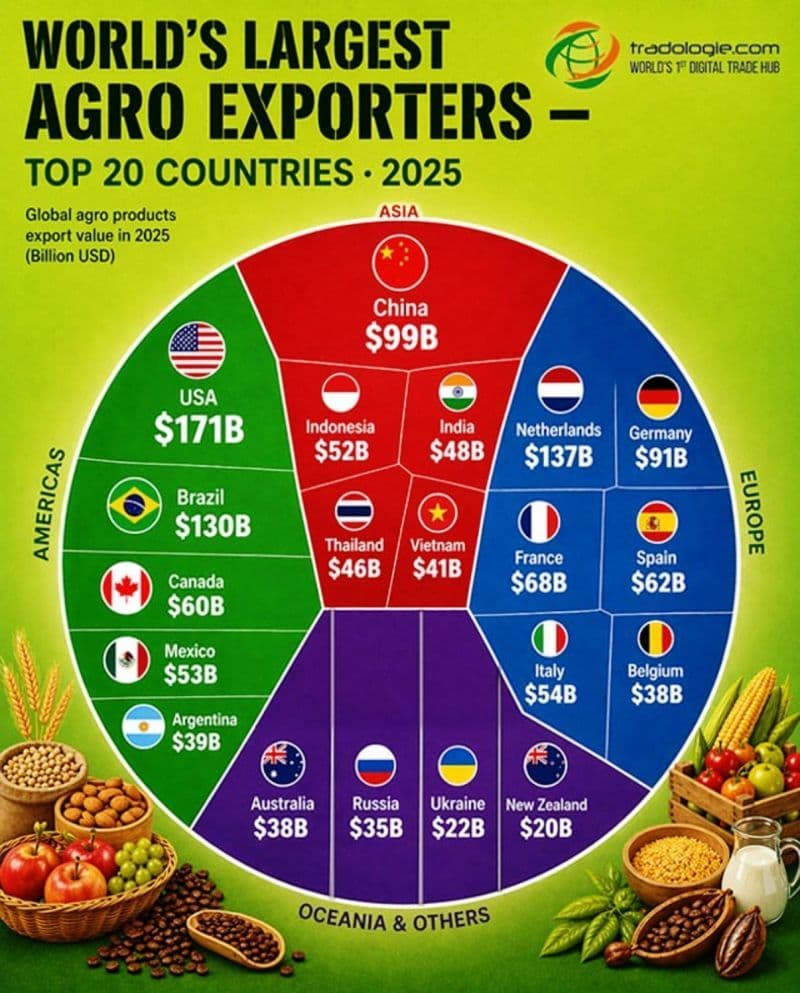
The United States remains the world’s leading agricultural exporter, with trade valued at approximately $171 billion. Its dominance is driven by deep integration between large-scale production, global trading houses, and sophisticated financial markets.
The Netherlands, ranking second with $137 billion, exemplifies the power of logistics. Leveraging the Port of Rotterdam and a highly efficient re-export system, the country exerts influence far beyond its geographic size.
Brazil, with exports totaling $130 billion, continues to emerge as a structural growth engine. Its role as a key supplier of soybeans and protein products—particularly to Asian markets—has cemented its importance in global supply chains.
Meanwhile, China, with $99 billion in exports, occupies a dual role as both one of the world’s largest agricultural importers and a rapidly growing exporter of processed goods.
Across Europe, countries including Germany, France, Spain, and Italy maintain strong positions in high-value segments such as processed foods, dairy products, and premium agricultural goods.
Emerging Regions Reshape Trade Flows
The global agricultural landscape is being reshaped by the rise of emerging markets and shifting geopolitical realities.
In Asia, countries such as Indonesia, India, Vietnam, and Thailand are rapidly expanding their export capabilities, intensifying competition and altering traditional trade routes.
At the same time, the Black Sea corridor—particularly involving Russia and Ukraine—continues to play a decisive role in global grain supply and pricing, with disruptions in the region having immediate ripple effects across international markets.
Oceania, led by Australia and New Zealand, is strengthening its position in premium agricultural exports, capitalizing on quality, traceability, and strong global branding.
Rising Risks and Strategic Opportunities
Analysts warn that agricultural commodities are becoming increasingly sensitive to external pressures, including climate change, supply chain disruptions, and geopolitical tensions.
Trade hubs and infrastructure operators are capturing a growing share of value, often outperforming primary producers. At the same time, concentration of supply in key regions is creating volatility, while also opening opportunities for strategic arbitrage.
“Demand shifts—particularly from Asia—are fundamentally reshaping global agricultural flows,” one market observer noted.
From Sector to Strategic Asset Class
The evolution of agricultural trade is redefining the sector as a strategic asset class.
Experts emphasize that integrated supply chains consistently outperform fragmented models, while logistics capabilities and access to financing are becoming decisive competitive factors. Market access—through trade agreements, infrastructure, and partnerships—is now as critical as production itself.
“Control of flows increasingly means control of value,” industry analysts say.
Industry Outlook
As global competition intensifies, businesses are being urged to strengthen their operational structures, invest in logistics and financing capabilities, and expand their international networks.
Organizations such as Commodity Trading Group are positioning themselves at the center of this transformation, offering strategic support and global connectivity to market participants, navigating an increasingly complex agricultural trade environment.