

CAC News
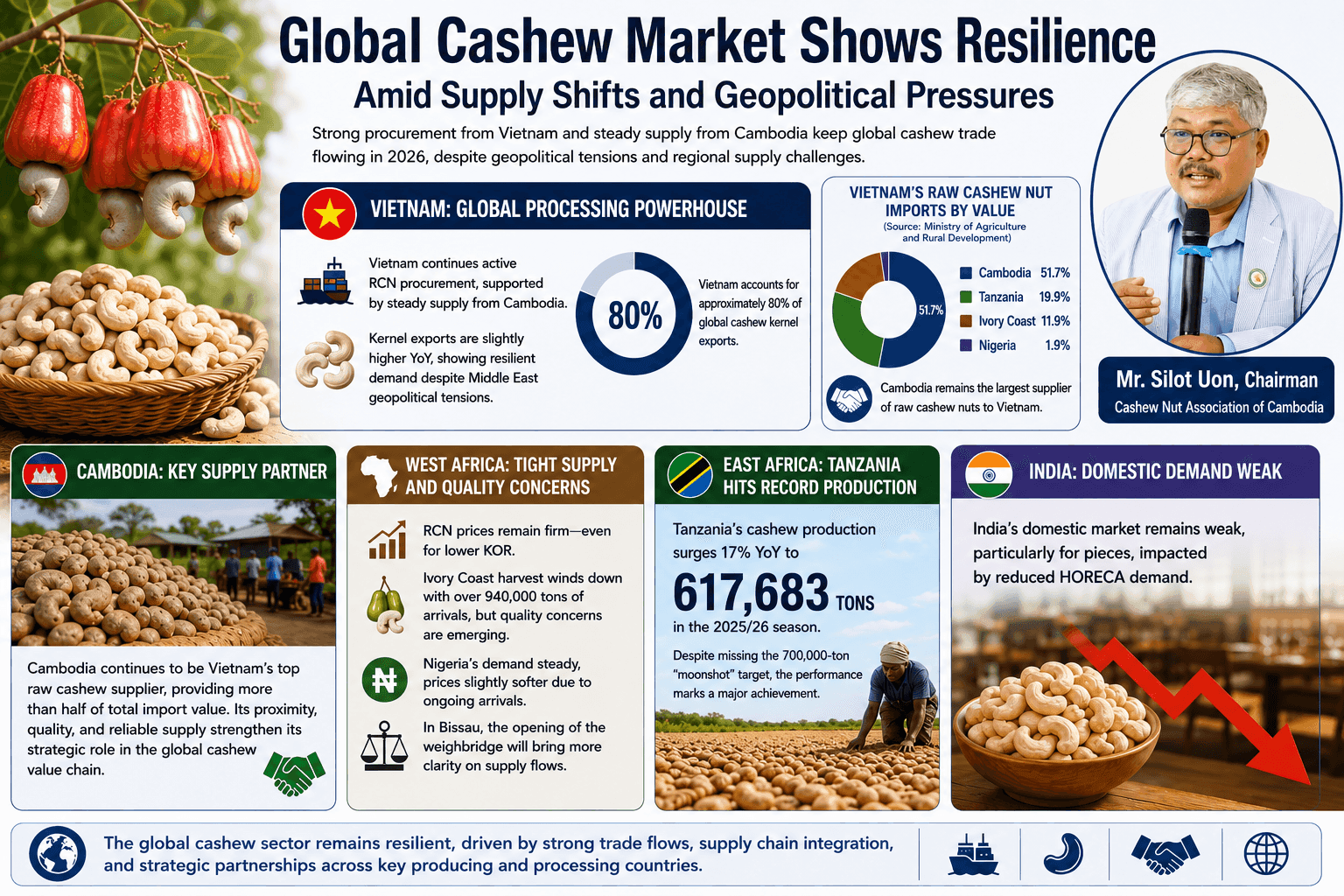
Phnom Penh, May 2026 — The global cashew market continues to demonstrate resilience in 2026, as strong procurement activity from Vietnam and stable raw cashew nut (RCN) supply from Cambodia help sustain international trade flows despite ongoing geopolitical tensions in the Middle East.
Market observers report that Vietnam remains actively engaged in RCN purchasing, supported largely by steady imports from Cambodia, which continues to serve as the country’s largest raw cashew supplier. Kernel exports from Vietnam have also shown a slight year-on-year increase, signaling resilient global demand despite uncertainty in international markets.
According to the Vietnam Cashew Association (Vinacas), Vietnam currently accounts for approximately 80 percent of global cashew kernel exports, reinforcing its dominant position in the international processing sector.
However, Vietnam’s processing industry remains heavily dependent on imported raw materials. Data from Vietnam’s Ministry of Agriculture and Rural Development indicates that Cambodia supplies 51.7 percent of Vietnam’s total raw cashew nut import value, maintaining its position as Vietnam’s largest supplier.
Tanzania accounts for 19.9 percent, the Ivory Coast for 11.9 percent, and Nigeria for 1.9 percent of Vietnam’s imports.
Cambodia Maintains Strategic Supply Role
Cambodia’s growing importance in the regional cashew supply chain continues to strengthen as demand from Vietnamese processors remains high. Silot Uon, chairman of CAC, notes that Cambodia’s proximity to Vietnam, expanding production base, and improving export logistics have positioned the country as a critical supplier within the global cashew trade network.
The continued procurement momentum also reflects stable confidence in Cambodian raw cashew quality and availability during the 2026 trading season.
West Africa Faces Tightening Supply and Quality Concerns
Meanwhile, in West Africa, raw cashew nut prices remain firm—even for lower Kernel Outturn Ratio (KOR) material—as arrivals of high-quality cashews begin to slow.
In Ivory Coast, market momentum is gradually easing as the harvest season approaches its conclusion. The country has recorded more than 940,000 tonnes of arrivals so far, although concerns are emerging regarding declining quality levels in some shipments.
Nigeria’s market remains relatively stable, supported by ongoing arrivals, though prices have softened slightly in recent weeks.
In Guinea-Bissau, traders are closely monitoring developments following the opening of the national weighbridge system, which is expected to provide clearer visibility into supply flows and export volumes in the coming days.
Tanzania Achieves Record Production
East Africa is also drawing significant attention this season, particularly Tanzania, where the cashew sector has experienced exceptional growth.
Tanzania’s 2025/26 cashew production has surged 17 percent year-on-year to a record 617,683 tonnes. Although the figure fell short of the government’s ambitious 700,000-tonne target, analysts describe the performance as a major achievement for the country’s expanding agricultural sector.
India Faces Weak Domestic Demand
On the demand side, India’s domestic cashew market remains under pressure, especially for lower-value kernel pieces. Industry sources attribute the slowdown largely to weaker demand from the hotel, restaurant, and catering (HORECA) sector.
Despite softer conditions in India, global demand overall has remained relatively stable, supported by continued buying activity in major international markets.
Analysts say the global cashew sector is increasingly shaped by supply chain integration, logistics efficiency, and regional trade relationships, with Cambodia continuing to emerge as a strategically important player in the international cashew economy.